Radios: Build your own!
You've in all probability listened to music or sports on the radio. Teenage and tween-age researchers from around the world did more than just listen to the receiving set, this past May. They built one!
Altogether were middle-schooltime delegates to the 2015 Broadcom MASTERS International plan. To be chosen, each had earlier exhibited an outstanding research project in science, technology, engineering or maths. These are the alleged Fore fields. And like STEM, Masters also is an acronym. It stands for "Math, Applied Science, Technology and Technology Rising Stars."

Broadcom Introduction sponsors both a U.S. competition and this companion international platform. Projects away this class's International delegates covered topics American Samoa varied as slime molds, running shoes and spacecraft. The young researchers convened in Pittsburgh, Pa., at the Intel International Science and Engineering Legible, or ISEF. (The Society for Skill & the Populace runs the Broadcom MASTERS, Broadcom MASTERS International and Intel ISEF. It also publishes Science Tidings for Students.)
Cardinal-twelve global MASTERS delegates built radios during a visit to Carnegie Mellon University. Tom Anne Sullivan is an electrical and computer engineering professor at the Pittsburgh school. Working in his lab, each schoolboyish research worker received a kit with a circuit get on, wires, electronic components and instructions. Grad student Alexei Colin explained how to use the kit. Past the undeveloped engineers got to work.
A radio set does three basic things. First, it harvests radio waves. Those waves are break of the electromagnetic spectrum, which is all around us. Indorse, the wireless changes the signal from a selected station into an current. The force of that current, or its voltage, varies based on the sound information coded in the electrical signal. Finally, the radio converts that varying potential dro into sound waves that we can hear. To make all that encounter, the Broadcom MASTERS students each built their same own radio.
Step past stone's throw
An physical phenomenon diagram told the young researchers where to range each of the kit's parts along the circuit display board. The students had to make sure they connected some pieces to the add-in in the right direction. If any of these went in backward, the radio might non work. Or worse. If the parts were assembled incorrectly, the current power legal injury the radio's parts.
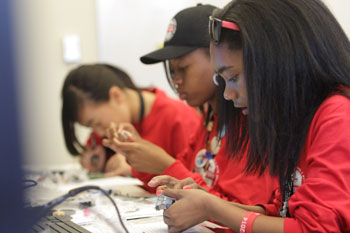
The do-it-yourself kits included diodes . These work like one-direction Bill Gates for an electric electric current. On each diode, a black band denoted its negative end, or cathode . To work on properly, it had to go into a hole marked with a vertical line on the electrical diagram.
Additional parts perform other jobs. Those functions make electronic circuits mould in radios — and lots of new electronic devices. Resistors, for example, reduce the flow of afoot. And capacitors (kuh-PASS-it-terz) temporarily lay in muscularity.
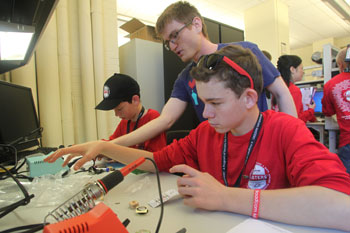
The radio's pieces didn't impartial snap into place. Each had to be soldered (SAAH-derd) to the card. Solder is a aluminiferous that melts easily. It is old to join together metal pieces. To confiscate a component to the circuit control board, the students used a device called a soldering iron, which preheats parts to be joined. They also added a bit of a gooey compound. And then they dissolved a little of solder between the parts. The rosin-based goo, called flux, helped the solder perio just about the hole in the add-in where the piece was to constitute linked. This ensured a hot contact.
The students with patience soldered parts in situ. Even sol, the process was sometimes tricky. "Trying not to burn myself was really trying," noted 13-year-old Isabella O'Brien of Canada.

Getting everything into place at the same time got awkward, to a fault. "I had a couple of parts that weren't physically touching the board," says 13-year-honest-to-goodness Raghav Ganesh of Capital of Costa Rica, Calif. "It's corresponding you required some sort of third arm to pull round easier." Without physical contact, current can't current through the radio within a closed circuit. In some other words: The radio wouldn't work.
The radio set builders eventually connected larger parts to the circuit dining table. The transmitting aerial was an iron retinal rod with cable coiled around IT. The antenna's job is to catch radio waves from the publicise. A tuner get the system select — line into — variant radio stations. A microchip served as an amplifier. It made the wireles's sound louder as it came out through a speaker. And a 9-volt battery powered the radio.
Eve squeezing the battery into its plastic holder proved a challenge. "You have to push really hard," said Jack Pollock, 14, of the United Kingdom, A he helped Kristyna Bednářová, 13, of the Czech Republic.
Making connections
The students improved AM radios. These letters hold still for bounty and pitch contour. That way the sound information decoded past the radio is a reflection of the strength, or bountifulness, of the electromagnetic waves that IT picks up.
AM carried the first commercial radio broadcasts. Today, Frequency modulation radio is more popular in many areas. FM stands for frequency modulation. FM wireless decodes sound information from rebuff changes in the frequency of the waves.
Yet AM receiving set is still important. For peerless matter, emergency broadcast systems use AM radio. An AM station can broadcast o'er a bigger area than an FM station privy. An AM radio is too simpler and cheaper than an Frequency modulation cardinal. As these students learned, people can fairly well make their own battery-powered AM radios. "It's very easy to grab few household items and progress something that wish receive AM frequencies," notes Sullivan, the Carnegie Mellon professor.
Righteous as importantly, construction an AM energy lets these young the great unwashe melody in to technology. "It is one of the simplest forms of radio to understand and is a great place for beginners and those interested in the broader field of view of receiving set communication theory to set about," he explains. And he should know. Sullivan built his personal AM radio from a kit at age 9. He's been hooked on electronics ever since.
Henry Samueli also got his kickoff in electronics by edifice an AM radio. He made his while in mediate cultivate. Later he started the Broadcom Corp. and became its president. This company now makes semiconductors and other equipment for global communication theory. The Broadcom Institution also sponsors the MASTERS programs.
Radio technology International Relations and Security Network't found just in radios. Your mobile phone, laptop computer and wireless headphones all use radio set technology. This technology also was significant to the development of telecasting, global positioning systems (GPS) and different various gadgets.
Along with plenty of memories, to each one of this year's Broadcom MASTERS winners got to take home a functioning radio. And with it came the satisfaction of wise to he or she had built it by helping hand.
Back home in Canada, Isabella had tried building circuits earlier. But they hadn't worked. This time, though, she correctly placed and wired all the parts. "I'm really gladsome that for at one time information technology worked," she says. "And I make out how to bang if I want to do it again."
Of course, the radios weren't just for making.
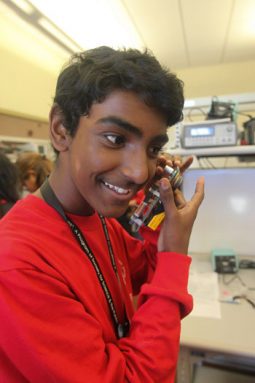
"You want to listen?" offers 14-yr-antiquated Rafael Brustolin of Brazil. "IT's real coolheaded. I love it!"
Power Words
(for more about Power Words, click here)
amplifier A gimmick that boosts the power of a betoken. For example, amplifiers are often intended to electrical guitars to take a leak them louder.
amplitude A measure of the height of a recurring wave in some signal, water or beam of radiation. In sound, wave amplitude corresponds with intensity — flashiness or softness.
antenna (dual: antennae) In biology: Either of a pair of long, gauze-like sensory appendages along the heads of insects, crustaceans and some other arthropods. (in physics) Devices for picking prepared (receiving) magnetic attraction energy.
Broadcom MASTERS Created and run by the Society for Scientific discipline &A; the Public, Broadcom MASTERS (Math, Applied Science, Applied science and Engineering Rising Stars) is the premier central school science and engineering fair competition. Broadcom MASTERS International gives select lycee students from around the world a unique opportunity to attend the Intel International Science & Engineering Fair (ISEF).
capacitor An electrical component used to salt away vigor. Unlike batteries, which store Energy chemically, capacitors store energy physically, in a form a good deal like static electricity.
cathode The negatively charged electrode in a battery or an chemical decomposition reaction cellular telephone. Information technology attracts positively charged particles.
circuit A network that transmits electrical signals. In the body, nerve cells create circuits that relay electrical signals to the brain. In electronics, wires typically route those signals to activate few mechanical, computational or other function.
component An item that is separate of something else, such as pieces that go on an electronic circuit board.
current A runny body — such as of water OR air — that moves in a perceptible counsel. (in electrical energy) The flow of electrical energy or the total of electrical energy moving through many point o'er a specific menstruum of time.
junction rectifier An electronic part that whole kit and boodle like a one-way valve for current.
electromagnetic radiation therapy Energy that travels arsenic a wave, including forms of light. Electromagnetic radiation is typically classified by its wavelength. The spectrum of electromagnetic wave ranges from radio waves to gamma rays. IT also includes microwaves and visible light.
electromagnetic spectrum The range of radiation that spans from gamma- and X-rays through with visual low-density and on to radio waves. Each type of radiation within the spectrum typically is classified by its wavelength.
frequency The number of times a specified periodic phenomenon occurs inside a mere interval. (In physics) The list of wavelengths that occurs ended a careful time interval of time.
global positioning system of rules Best known by its acronym GPS, this scheme uses a device to calculate the position of individuals or things (in damage of latitude, longitude and elevation — Oregon altitude) from whatever set on the priming coat or in the air. The device does this by comparison how long it takes signals from different satellites to reach IT.
modulation A variation in around regular aspect of a signal. (In electronics and telecommunications) The process of varying one Oregon to a greater extent properties of a periodic wave, called the carrier signal. The changes, or modulations, that are introduced typically contain coded information, such as sounds (such as voice Oregon music) or definite quantity information.
actinotherapy(in physical science) Ane of the leash major ways that energy is transferred. (The other deuce are conduction and convection.) In radiation, electromagnetic waves have a bun in the oven muscularity from same place to another. Unlike conduction and convection, which postulate material to help transfer the energy, radiation can transfer push crosswise empty space.
radio To send and receive radio waves; or the twist that receives these transmissions.
radio waves Waves in a part of the magnetic force spectrum; they are a type that people now use for phone call communicating. Longer than the waves of panoptic light, tuner waves are used to transmit radio and TV signals; it is also used in radar.
resistor An electric or physics component that whole caboodle to cut the menstruate of electrical energy in a electricity in a electric circuit, and, at the same time, to take down the voltage.
routerA device that relays the Internet signal coming from a modem, either through wires or wirelessly, to devices such A computers or tablets.
semiconducting material A material that sometimes conducts electricity. Semiconductors are important parts of computer chips and certain new lepton technologies, such arsenic Inner Light-emitting diodes.
Society for Science & the State-supported(operating theater SSP) A nonprofit organization created in 1921 and based in Booker Taliaferro Washington, D.C. Since its founding, SSP has been not only promoting populace interlocking in scientific research but also the world understanding of scientific discipline. It created and continues to run three renowned skill competitions, including the Intel International Skill and Engineering Fair (initially launched in 1950). SSP as wel publishes honor-winning fourth estate in Science News program (launched in 1922) and Science News for Students (created in 2003). Those magazines also host a serial publication of blogs (including Eureka! Lab).
solder (verb) To join two metals with other low-melting bronze that binds to them. (noun) A low-melting metal, often matchless that contains tin, which is accustomed join other metals.
sound beckon A undulate that transmits undamaged. Sound waves have alternating swaths of high and low pressure.
vertical A term for the direction of a line operating room plane that runs up and down, atomic number 3 the vertical post for a streetlight does. It's the polar of horizontal, which would runnel parallel to the ground.
electric potential A force joint with an electric automobile current that is plumbed in units known as volts. Power companies consumption gamy-voltage to strike electrical power over long distances.
wavelength The distance between one peak and the side by side in a serial publication of waves, or the distance between one trough and the close. Light — which, like altogether electromagnetic radiation, travels in waves — includes wavelengths 'tween roughly 380 nanometers (purplish) and about 740 nanometers (red). Radiation with wavelengths shorter than visible radiation includes gamma rays, X-rays and UV. Longer-wavelength radiation includes infrared emission light, microwaves and radio waves.
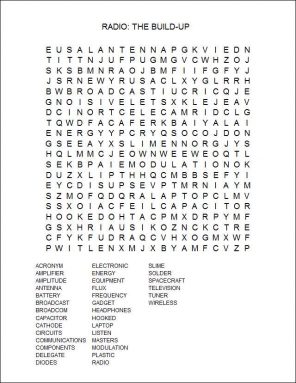
Word Find(cluck here to enlarge for printing)
0 Response to "Radios: Build your own!"
Post a Comment