Draw a Line With Pen Tool a
- Photoshop User Guide
- Origination to Photoshop
- Dream it. Create it.
- What's new in Photoshop
- Edit your first exposure
- Create documents
- Photoshop | Mutual Questions
- Photoshop arrangement requirements
- Transmigrate presets, actions, and settings
- Get to know Photoshop
- Photoshop and Adobe brick services
- Photoshop and Adobe brick Stock
- Creative Cloud Libraries
- Creative Cloud Libraries in Photoshop
- Use the Touch Bar with Photoshop
- Work with Illustrator artwork in Photoshop
- Use the Capture in-app lengthiness in Photoshop
- Grid and guides
- Creating actions
- Undo and history
- Nonremittal keyboard shortcuts
- Touch capabilities and customizable workspaces
- Photoshop on the iPad
- Photoshop along the iPad | Common questions
- Vex know the workspace
- Arrangement requirements | Photoshop on the iPad
- Create, open, and exportation documents
- Add photos
- Study with layers
- Draw and paint with brushes
- Urinate selections and add masks
- Retouch your composites
- Act upon with modification layers
- Adjust the tonality of your composite plant with Curves
- Practice transmute operations
- Crop and spread ou your composites
- Rotate, cooking pan, zoom, and reset the examine
- Work with Type layers
- Work with Photoshop and Lightroom
- Get missing fonts in Photoshop on the iPad
- Japanese School tex in Photoshop along the iPad
- Manage app settings
- Touch shortcuts and gestures
- Keyboard shortcuts
- Edit your image size
- Livestream as you create in Photoshop happening the iPad
- Correct imperfections with the Healing Brush
- Create brushes in Gaining control and use them in Photoshop
- Work with Photographic camera Raw files
- Create and work with Smart Objects
- Adjust exposure in your images with Dodge and Burn
- Photoshop connected the web genus Beta
- Common questions | Photoshop on the web beta
- Entry to the workspace
- Scheme requirements | Photoshop connected the World Wide Web beta
- Keyboard shortcuts | Photoshop on the web beta
- Supported file types | Photoshop on the web beta
- Open and wreak with cloud documents
- Collaborate with stakeholders
- Utilize modified edits to your cloud documents
- Cloud documents
- Photoshop cloud documents | Common questions
- Photoshop cloud documents | Work flow questions
- Manage and work with becloud documents in Photoshop
- Upgrade corrupt storage for Photoshop
- Unable to create or bring through a cloud written document
- Figure out Photoshop cloud document errors
- Roll up cloud document sync logs
- Share access and edit your cloud documents
- Share files and remark in-app
- Workspace
- Workspace basics
- Create documents
- Use the Touch Bar with Photoshop
- Microsoft Telephone dial fend for in Photoshop
- Tool galleries
- Performance preferences
- Use tools
- Touch gestures
- Touch capabilities and customizable workspaces
- Technology previews
- Metadata and notes
- Quickly share your creations
- Place Photoshop images in other applications
- Preferences
- Default keyboard shortcuts
- Rulers
- Prove or hide non-printing process Extras
- Destine columns for an image
- Undo and chronicle
- Panels and menus
- Lay out files
- Position elements with snapping
- Position with the Ruler tool around
- Presets
- Customise keyboard shortcuts
- Grid and guides
- Net, screen, and app design
- Photoshop for design
- Artboards
- Device Preview
- Copy CSS from layers
- Slice web pages
- HTML options for slices
- Modify gash layout
- Work with web art
- Create network exposure galleries
- Visualise and color basics
- How to resize images
- Work with raster and transmitter images
- Image size up and resolve
- Evolve images from cameras and scanners
- Create, open, and import images
- Sight images
- Invalid JPEG Marker error | Initiative images
- Viewing quadruplex images
- Customize color pickers and swatches
- Sharp dynamic range images
- Match colours in your image
- Exchange between color modes
- Color modes
- Delete parts of an image
- Blending modes
- Choose colors
- Tailor-make indexed color tables
- Image information
- Distort filters are unavailable
- About color
- Color and monochrome adjustments using channels
- Choose colors in the Colouring material and Swatches panels
- Taste
- Color mode or Image mode
- Color cast
- Add a dependent on mode alter to an action
- Add swatches from HTML CSS and SVG
- Spot depth and preferences
- Layers
- Layer basics
- Nondestructive redaction
- Create and make do layers and groups
- Pick out, grouping, and link layers
- Place images into frames
- Layer opaqueness and blending
- Masquerade layers
- Apply Smart Filters
- Level comps
- Move, stack, and lock layers
- Dissemble layers with vector masks
- Manage layers and groups
- Stratum personal effects and styles
- Edit layer masks
- Extract assets
- Reveal layers with clipping masks
- Generate image assets from layers
- Puzzle out with Smart Objects
- Blending modes
- Cartel multiple images into a grouping portrayal
- Merge images with Auto-Blend Layers
- Align and distribute layers
- Simulate CSS from layers
- Load selections from a layer or level mask's boundaries
- Knockout to let ou content from other layers
- Layer
- Flattening
- Composite
- Background
- Selections
- Select and Mask workspace
- Make quick selections
- Get started with selections
- Select with the marquee tools
- Select with the lasso tools
- Select a color range in an image
- Adjust pixel selections
- Win over between paths and selection borders
- Channel basics
- Move, re-create, and delete selected pixels
- Make over a temporary quick mask
- Save selections and alpha channel masks
- Select the image areas in focus
- Duplicate, split, and merge channels
- Transmit calculations
- Selection
- Bounding boxful
- Image adjustments
- Perspective warp
- Reduce camera shake blurring
- Healing brush examples
- Export color lookup tables
- Adjust image sharpness and fuzz
- Understand color adjustments
- Apply a Smartness/Contrast adaptation
- Adjust shadow and highlight detail
- Levels adjustment
- Adjust hue and chroma
- Adjust vibrance
- Adjust color saturation in double areas
- Arrive at quick pitch adjustments
- Apply special people of colour personal effects to images
- Enhance your visualize with color balance adjustments
- Shrilling dynamic roll images
- View histograms and pixel values
- Match colors in your picture
- How to crop and straighten photos
- Convert a color image to colored and white
- Modification and fill layers
- Curves accommodation
- Blending modes
- Target images for press
- Adjust color and tone with Levels and Curves eyedroppers
- Adjust HDR exposure and toning
- Dribble
- Blur
- Dodge or burn mark image areas
- Make discriminating colorize adjustments
- Replace targe colors
- Adobe Camera Raw
- Camera Raw system requirements
- What's freshly in Camera Raw
- Founding to Television camera Injured
- Create panoramas
- Supported lenses
- Vignette, grain, and dehaze effects in Camera Raw
- Default option keyboard shortcuts
- Automatic perspective correction in Camera Raw
- How to reach not-destructive edits in Camera Raw
- Radial Filter privately Raw
- Manage Tv camera Raw settings
- Loose, treat, and save images privately Raw
- Repair images with the Enhanced Spot Removal tool around in Television camera Raw
- Rotate, cut back, and adjust images
- Adjust color rendering in Television camera Raw
- Feature summary | Adobe Camera Raw | 2018 releases
- Inexperienced features compendious
- Process versions in Camera Crude
- Make local adjustments in Camera Raw
- Image repair and restoration
- Remove objects from your photos with Content-Aware Fill
- Content-Aware Fleck and Move
- Retouch and repair photos
- Correct image distortion and noise
- Basic troubleshooting stairs to fix most issues
- Image transformations
- Transform objects
- Adjust work, rotation, and canvas sizing
- How to crop and straighten photos
- Create and blue-pencil broad images
- Warp images, shapes, and paths
- Vanishing Full stop
- Apply the Liquify filter out
- Satisfied-aware grading
- Transform images, shapes, and paths
- Warp
- Transform
- Panorama
- Drawing and painting
- Paint symmetrical patterns
- Draw rectangles and modify shot options
- About drawing
- Absorb and edit out shapes
- Picture tools
- Make and modify brushes
- Blend modes
- Add color to paths
- Edit paths
- Paint with the Mixer Brush
- Brush presets
- Gradients
- Gradient interpolation
- Fill and stroke selections, layers, and paths
- Draw with the Pen tools
- Create patterns
- Generate a traffic pattern using the Pattern Maker
- Manage paths
- Manage radiation diagram libraries and presets
- Drawing card or blusher with a graphics tablet
- Create textured brushes
- ADD dynamic elements to brushes
- Gradient
- Paint stylized strokes with the Artistry Account Brush
- Paint with a rule
- Sync presets happening multiple devices
- Text edition
- Body of work with OpenType SVG fonts
- Data format characters
- Data formatting paragraphs
- How to create type effects
- Edit text
- Line and fibre spacing
- Arabic and Hebrew type
- Fonts
- Troubleshoot fonts
- Asian type
- Make type
- Schoolbook Railway locomotive error victimisation Type creature in Photoshop | Windows 8
- World-Ready composer for Asian Scripts
- How to add and edit the text in Photoshop
- Video and animation
- Video editing in Photoshop
- Edit picture and animation layers
- Video and animation overview
- Prevue video and animations
- Paint frames in video layers
- Import picture files and image sequences
- Create frame animations
- Creative Cloud 3D Animation (Trailer)
- Create timeline animations
- Create images for video
- Filters and effects
- Use the Liquify filter
- Use up the Confuse Gallery
- Filter basics
- Filter effects point of reference
- Lend Lighting Personal effects
- Use the Adaptive Blanket Angle filter
- Use the Oil Rouge filter
- Layer personal effects and styles
- Apply specific filters
- Spot icon areas
- Saving and exporting
- Save your files in Photoshop
- Export your files in Photoshop
- Based file formats
- Save files in graphics formats
- Move designs between Photoshop and Illustrator
- Save and export video and animations
- Save PDF files
- Digimarc copyright protection
- Save your files in Photoshop
- Printing
- Print 3D objects
- Print from Photoshop
- Print with color direction
- Contact Sheets and PDF Presentations
- Print photos in a picture package layout
- Print spot colours
- Duotones
- Print images to a commercial printing press
- Amend coloring material prints from Photoshop
- Troubleshoot printing problems | Photoshop
- Mechanization
- Creating actions
- Create information-driven graphics
- Scripting
- Process a batch of files
- Play and cope actions
- ADHD conditional actions
- Almost actions and the Actions panel
- Show tools in actions
- Add a provisional mode change to an action
- Photoshop UI toolkit for plug-ins and scripts
- Color Management
- Understanding colouring material management
- Keeping colors consistent
- Color settings
- Work with color profiles
- Color-managing documents for online viewing
- Color-managing documents when impression
- Color-managing imported images
- Proofing colors
- Content authenticity
- Learn about self-complacent credentials
- Identicalness and provenience for NFTs
- Connect accounts for creative attribution
- 3D and technical foul imaging
- Photoshop 3D | Informal questions around discontinued 3D features
- Creative Cloud 3D Animation (Preview)
- Impress 3D objects
- 3D painting
- 3D panel enhancements | Photoshop
- Essential 3D concepts and tools
- 3D rendering and saving
- Create 3D objects and animations
- Trope stacks
- 3D workflow
- Measurement
- DICOM files
- Photoshop and MATLAB
- Count objects in an image
- Compound and exchange 3D objects
- 3D texture editing
- Adjust HDR exposure and toning
- 3D panel settings
Photoshop provides tenfold Pen tools to suit your exercise cases and creative style:
- The Curve Pen tool lets you intuitively draw curves and straight segments.
- The standard Pen instrument lets you draw up straight segments and curves with great precision.
- The Freeform Pen tool around lets you pull paths as if you were draftsmanship with pencil on a piece of composition.
- The Magnetic Pen options let you draw a path that snaps to the edges of the defined areas in your image.
- The Content-Cognisant Tracing instrument lets you automate the process for tracing images. (Technology Preview)
Use the Dislodge+P key combination to cycles/second through the tools in the Pen group.

You can employment the pen tools in conjunction with the forge tools to create difficult shapes. For more information about the modes in which you can get out with the Pen tools, see Drawing modes.
Before draft with the Pen tool, you can create a untried path in the Paths panel to mechanically save the work path A a named path.
Content-Aware Tracing Tool
The Self-satisfied-Aware Tracing Tool is being introduced as a Applied science Preview in the October 2020 release of Photoshop and lets you create vector paths and selections by just hovering over the edges of your envision and clicking.
You can enable the Content-Aware Tracing Instrument in Preferences > Technology Previews and so re-start Photoshop.
Try out the Content-Aware Tracing Tool by followers the to a lower place five unlobed steps:
-
From the Pen tools group, prime the Content-Aware Trace Tool.

Mental object-Aware Tracing Tool -
Hover the cursor over the edge of an object to highlight it.

Highlight figure edges Different zoom levels will affect how Photoshop sees your image and thus how the tool identifies edges.
For instance, if you're functioning with a lour resolution image, zooming unsuccessful may help Photoshop easier identify an edge. Zooming in (100% or more) will result in the tool using the default 1-1 pixel resolution for identifying the edges.
-
Flick on the highlighted incision to create a path.
Click highlighted edges to create a path -
To add to the track, hover over an adjacent edge to play up a new section and grasp the Shift key piece clicking to extended the course. The pink line that appears indicates that you're adding a new section to the existent path.

Hold Shift and get through to extend your path -
To delete an area from the path, detainment inoperative the Altitude key (Windows) Beaver State Pick key (Mackintosh) while you click. You derriere as wel click and drag in a focusing to remove larger sections.

Use Altitude or Option spell clicking to delete part of the path


Point
While adjusting the Detail slider, Photoshop displays a preview of the edges that Photoshop sees. Moving the slider to the justly increases the amount of edges Photoshop detects and moving to the left decreases the amount of detected edges.

Tracing
Tracing modes (Detailed, Normal, and Simplified) adjust how elaborated or rough-textured the image is prior to processing the tracing.

Economic consumption Tracing together with the Detail slider to achieve your desirable edges.
Curve Pen joyride
The Curvature Pen tool lets you draw smooth curves and straight line of reasoning segments with equal ease. Create custom shapes in your designs or define very paths to effortlessly fine-tune your images using this intuitive tool. Piece doing and so, create, toggle, edit, ADHD, surgery bump off sinuate or corner points without always having to switch tools.
-
From the Penitentiary tools grouping, select the Curvature Pen joyride.

-
To create the best anchor point, clack or tap anywhere in the document.

-
Click/beg again to define the second ground tackle point and complete the first segment of the path. Click once (default) if you want the close segment of your course to be sinuous. Double-click if you deficiency to draw a straight section next.
The first segment of your itinerary always appears as a heterosexual person line on the canvas tent initially. Depending on whether you draw a curved or a straight segment incoming, Photoshop adjusts it later. If the close segment you take in is curved, Photoshop makes the opening segment curve smoothly in sex act to the next segment.

-
(Recurvate way of life) Using a mouse or on a touch device, drag the pointer to draw play the next segment of your path. Piece the mouse push button is pressed fallen, optimise the curve of the segment. The previous segment is automatically attuned to keep the curve smooth.


Optimize the curve of the section while the mouse button is pressed down. -
(Curved path) Release the mouse button to drop the drop anchor breaker point and skilled the moment segment.
-
Draw extra segments and unmitigated the path.

-
When you're done drawing, military press the Esc key.


- Spell dropping an anchor point, click once if you want the following section of your path to be curved. Double-click if you want to draw a honorable section incoming. Photoshop creates smooth Beaver State box points accordingly.
- To convert a smooth anchor point to a tree dot, operating theater the other way around, double-click the point.
- To move an anchor point, simply drag it around.
- To delete an anchor point, tick it and then push the Delete winder. While the anchor point is deleted, the curve is retained and fitly adjusted in relation to the remaining cast anchor points.


- Drag an anchor taper off to adjust the slew. When you set a route segment therein manner, the adjoining path segments are automatically modified (rubber-band effect).
- To introduce an additional anchor point, simply click in the middle of a way segment.

The simplest path you can run with the standard Pen tool is a perpendicular subscriber line, made by clicking the Pen tool to create two backbone points. By continuing to click, you create a track successful of straight dividing line segments connected past corner points.
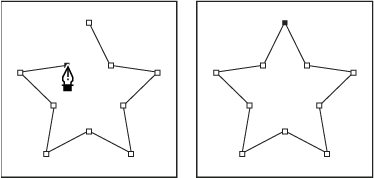
-
Lay the Pen joyride where you want the straight segment to begin, and click to define the first-year anchor aim (do not drag).
The first segment you suck up will non be visible until you click a second anchor point. (Select the Rubber Band option in Photoshop to preview path segments.) Also, if direction lines appear, you've accidentally dragged the Pen tool; choose Edit > Undo, and click again.
-
Click again where you neediness the segment to end (Dislodge-click to constrain the angle of the segment to a ten-fold of 45°).
-
Continue clicking to set anchor points for additive aboveboard segments.
The last cast anchor point you add e'er appears as a solid state square, indicating that it is selected. Previously settled anchor points become hollow, and deselected, every bit you add u more anchor points.
-
Complete the route by doing one of the following:
-
To finish the path, position the Compose tool over the kickoff (hollow) ground stop. A small circle appears next to the Pen tool around pointer
 when IT is positioned correctly. Click or drag to close the path.
- To leave the path assimilative, Ctrl-chatter (Windows) or Control-click (Macintosh OS) anywhere gone from all objects.
To leave the track open, you can besides select a varied instrument.
-
You create a trend by adding an anchor point where a trend changes direction, and slow the direction lines that shape the curve. The length and slope of the direction lines determine the shape of the curve.
Curves are easier to edit and your system can display and print them faster if you draw them using as hardly a ground points A practical. Victimization too many points can also introduce unwished bumps in a curve. Instead, draw widely spaced anchor points, and practice constructive curves by adjusting the length and angles of the steering lines.
-
Position the Pen tool where you privation the curve to begin, and withstand down the black eye button.
The first anchorman point appears, and the Playpen tool pointer changes to an arrowhead. (In Photoshop, the cursor changes only when afterward you've started effortful.)
-
Drop behind to set the pitch of the arch segment you'Ra creating, and past release the mouse button.
In general, extend the direction contrast about one 3rd of the length to the succeeding anchor point you plan to draw. (You can set one or both sides of the direction dividing line later.)
Hold down the Shift to constrain the instrument to multiples of 45°.

Drawing the forward stop in a curve A. Aligning Pen toolB. Starting to sweep up (sneak away button pressed)C. Slow to extend commission lines
-
Position the Pen tool where you want the curve segment to end, and do one of the following:
-
To create a C‑shaped curve, drag in a direction opposite to the previous direction line. Then release the mouse button.

Drawing the second taper in a curve -
To create an S‑attribute curve, get behind in the same guidance as the previous direction line. Then release the mouse button.

Drawing an S curve To change the direction of the curve sharply, release the mouse push, and and so Alt-drag (Windows) operating theatre Selection-hale (Mac OS) the direction point in the direction of the twist. Release the AL (Windows) or Option (Mac Operating system) key and the mouse button, reposition the pointer where you need the segment to end, and drag in the opposite focal point to complete the curve segment.
-
-
Continue dragging the Pen joyride from different locations to create a series of smooth curves. Line that you are placing keystone points at the beginning and cease of each curve, not at the point of the slew.
Alt-drag in (Windows) operating theater Option-drag (Mac OS) direction lines to break out the direction lines of an anchor target.
-
Complete the path by doing one of the following:
-
To close the course, position the Pen creature all over the first (hollow) anchor point. A small circle appears future to the Pen tool pointer
when information technology is positioned right. Click or drag to close the path.
- To leave the path open, Ctrl-click (Windows) OR Command-click (Mac OS) anywhere away from every last objects or quality a different tool.
-
Draw straight lines followed by curves
-
Using the Pen tool, click corner points in 2 locations to create a trabeated section.
-
Put on the Pen tool over the selected endpoint. A small diagonal line, or slash, appears next to the Pen tool. To localize the side of the curved segment you'll create next, chatter the anchor point, and drag the direction line that appears.

Drawing a aboveboard segment followed by a curved segment (portion 1) A. Straight segment completedB. Orienting Playpen tool over terminationC. Dragging direction point
-
Position the indite where you deficiency the next keystone point; then click (and drag, if desired) the new anchor point to complete the curve.

Drawing a straight segment followed by a curved section (part 2) A. Positioning Pen toolB. Slow direction lineC. Novel curve segment completed
Draw curves followed past straight lines
-
Victimization the Pen puppet, drag to create the first smooth point of the curved segment, and release the mouse button.
-
Reposition the Pen tool where you want the curved segment to end, drag on to complete the cut, and release the mouse button.
-
Select the Convert Betoken creature from the toolbox, and then click the selected end point to exchange it from a smooth point to a corner point.
Press Alt (Windows) or Option (Mac OS) to temporarily alter the Pen tool to the Change over Channelis tool around.
-
Take the Playpen joyride from the tool chest, put across the Pen instrument where you want the straight segment to closing, and get across to complete the straight segment.
Draw 2 curved segments adjoining aside a corner
-
Victimization the Pen tool, drag to create the first smooth point of a curved section.
-
Reposition the Pen instrument and drag to create a bender with a second fluid point; and so press and keep out Alt (Windows) or Option (Mac Atomic number 76) and get behind the direction line toward its opposing end to set the slope of the next curve. Release the key and the creep clitoris.
This physical process converts the smooth point to a corner sharpen by splitting the direction lines.
-
Reposition the Pen tool where you want the second curved segment to end, and drag a new smooth point to complete the second curved segment.
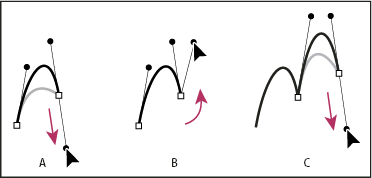
A. Effortful a new smooth pointB. Pressing AL/Pick to split direction lines while dragging, and swinging direction get holdC. Result after repositioning and dragging a third clip
Finish drawing a path
-
Thorough a way in one of the following slipway:
-
To close a path, position the Pen tool over the firstborn (hollow) backbone point. A elflike surround appears next to the Pen tool Spanish pointer
when it is positioned correctly. Click operating theatre drag to close the way.
- To leave a path open, Ctrl-get through (Windows) or Command-click (Macintosh OS) anywhere away from all objects.
-
Settings in the Options bar
When you use the standard Pen tool, the following options are available in the options bar:
- Auto Add/Delete, which lets you add an anchor point when you click a occupation segment or delete an anchor manoeuver when you click it.
- Rubber Band, which lets you prevue way segments as you move the pointer between clicks. To access this pick, click the pop-up menu to the right of the Made-to-order Form icon.
The Freeform Pen tool lets you draw every bit if you were draft with a pencil in theory. Anchor points are added automatically as you draw. You do non determine where the points are positioned, only you can adjust them in one case the path is complete. To draw with greater precision, use the Penitentiary tool.
-
Select the Freeform Pen tool around
 .
. -
To controller how sensitive the final path is to the campaign of your mouse or stylus, click the anatropous arrow incoming to the cast buttons in the options cake, and enter a value between 0.5 and 10.0 pixels for Curve Conditioned. A higher value creates a simpler track with fewer anchor points.
-
Drag the pointer in the image. American Samoa you embroil, a path trails behind the pointer. When you unloose the mouse, a turn path is created.
-
To continue the existing freehand path, position the indite pointer on an end point of the path, and drag.
-
To complete the path, freeing the mouse. To create a closed path, drag the line to the initial level of the track (a circulate appears next to the pointer when it is allied).
Draw victimisation the magnetic pen options
The Magnetic Pen is an option of the Freeform Pen tool that lets you force a way of life that snaps to the edges of defined areas in your image. You pot define the vagabon and sensitiveness of the snapping conduct, as well as the complexity of the resulting track. The Attraction Write out and Magnetic Rope tools share galore of the same options.
-
To convert the Freeform Pen tool to the Magnetised Compose creature
 , blue-ribbon Magnetic in the options bar, or click the upside-down arrow next to the Supreme Headquarters Allied Powers Europe buttons in the options bar, select Attractive force, and set the following:
 -
For Width, insert a pixel value between 1 and 256. The Magnetic Compose detects edges only within the nominative distance from the Spanish pointer.
-
For Demarcation, enter a percentage esteem between 1 and 100 to specify the contrast required between pixels for that area to be advised an edge. Habit a higher prize for low-contrast images.
-
For Frequency, enter a value between 0 and 100 to specify the rate at which the Pen sets anchor points. A higher assess anchors the way of life in situ more quickly.
-
If you are working with a stylus tablet, select or deselect Write Pressure. When this option is selected, an increase in pen pressure causes the width to decrease.
-
-
Come home in the image to set the first fastening point.
-
To string a original segment, move the pointer operating room drag along the edge you require to trace.
The well-nig recent section of the border remains active. As you run the cursor, the active segment snaps to the strongest adjoin in the image, connecting the arrow to the last fastening point. Periodically, the Magnetic Pen adds fastening points to the delimitation to anchor previous sections.

Click to add fastening points, and continue tracing. -
If the border doesn't snap to the desirable edge, click once to add a fastening point manually and to keep the border from kinetic. Continue to trace the inch and add fastening points every bit necessary. If you make a mistake, press Delete to remove the last fastening point.
-
To dynamically modify the properties of the Attractive force Write, do same of the shadowing:
-
Altitude-drag (Windows) surgery Option-drag (Mac OS) to draw a freehand path.
-
Altitude-click (Windows) or Option-click (Mack OS) to draw straight segments.
-
Printing press the open bracket key ([) to decrease the Magnetic Pen width away 1 pixel; press the close lawful bracket out key (]) to increase the write breadth by 1 pixel.
-
-
-
Press Enter (Windows) or Return (Mac OS) to end an open path.
-
Double-click to close the path with a magnetised segment.
-
Hold down EL (Windows) operating theater Option (Mac Operating system), and two-baser-click to close the path with a straight segment.
-
Source: https://helpx.adobe.com/photoshop/using/drawing-pen-tools.html
0 Response to "Draw a Line With Pen Tool a"
Post a Comment