This outstanding International GCSE Fine art and Design Coursework projection was completed by Manisha Mistry in 2003, while studying IGCSE Art and Design (CIE 0400) at ACG Strathallan Higher, Auckland, New Zealand. A highly talented student, Manisha gained a result of 98% for her Coursework projection. She submitted an A3 sketchbook and a final painting (A2) that were based on a 'Coastal Environment' theme, exploring natural forms such every bit shells, plants and landscapes. This was a theme prepare by the teacher and interpreted individually by students. The year's course was broken into a number of smaller assignments that were explored over the following sketchbook pages.Note: In 2003 the Coursework requirement was for a final project + sketchbook, rather than the A2 portfolio of iv sheets (8 sides) that is the maximum requirement today.
It is hoped that this case report will benefit a range of high school Art students, including those who report GCSE Art and IGSCE Art and Design.
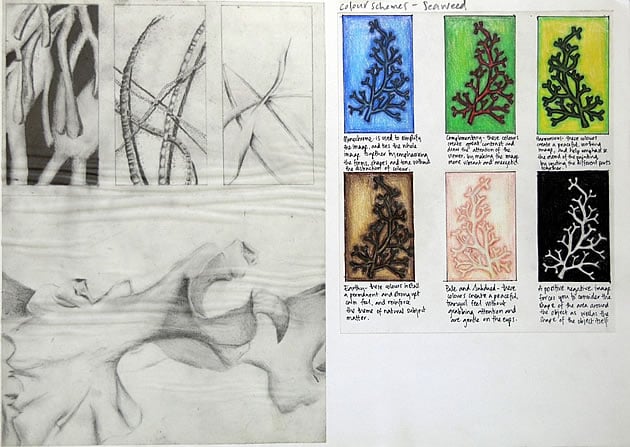
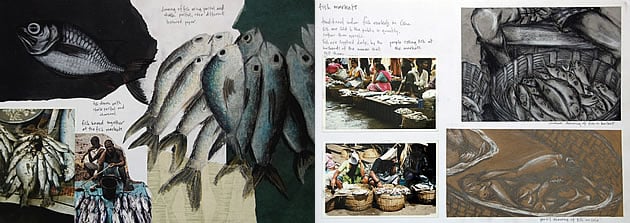
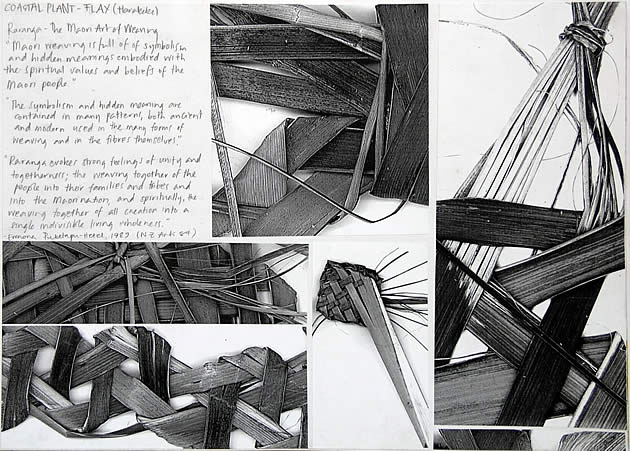
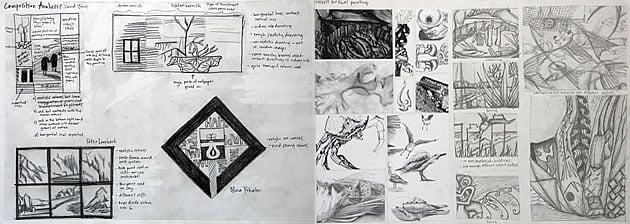
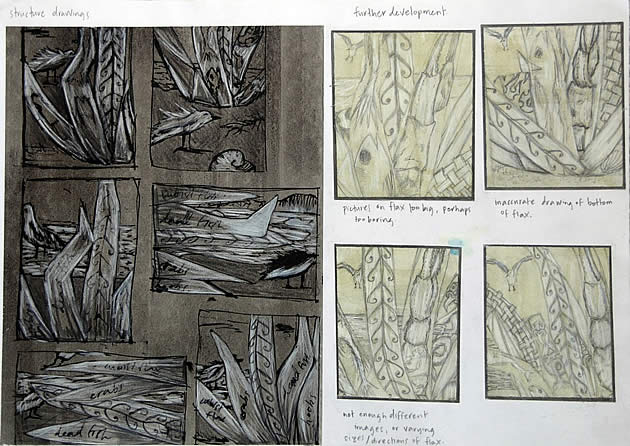
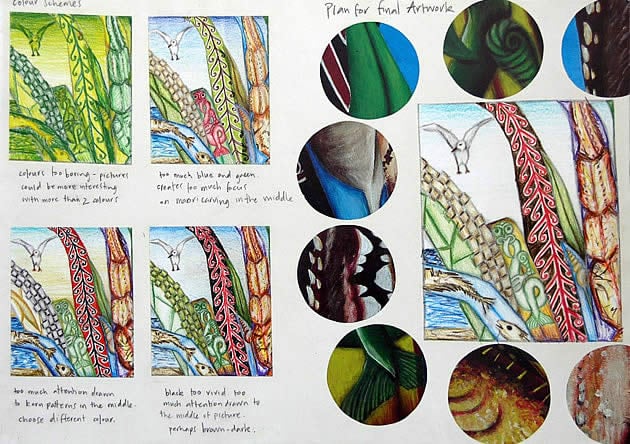
Observational drawing is a large function of IGCSE Art. For her first sketchbook page Manisha arranged shells inside cardboard boxes (giving her ample opportunity to practise the depiction of space), contrasting natural forms with the athwart edges of boxes. She used a wash of earthy ochres and dejection to create an acrylic ground, and used graphite and white paint over this to employ calorie-free and nighttime tone to the organic shell forms.Experimentation and media trials are an of import function of the IGCSE Fine art and Design (CIE) form. This sketchbook folio includes confident and sophisticated experimentation with line (hatching and rendering techniques) also as with several wet mediums, including acrylic paint, water colour and Indian ink. Manisha has used several different techniques, including applying paint with a stick, sponge and dripping splashes of ink onto a watery footing. Exercises such as this are fun and relatively quick for students to complete.Manisha'due south International GCSE Art sketchbook layout is clean and uncluttered, without unnecessary ornament. This folio contains beautifully simple observational drawings of natural forms (seaweed), besides as an investigation into the mood / colour associations.This is one of my favourite pages in Manisha's IGCSE Fine art Sketchbook. A cracking tip for International GCSE students is to use a range of grounds and drawing surfaces within their sketchbook. This exposes students to a wide range of mediums and encourages experimentation. Information technology besides tends to create a rich, tactile sketchbook with visual appeal. In this sketchbook folio, Manisha has glued a piece of dark-brown paper to the left hand side of the folio and used this as a mid-tone ground for a black and white charcoal drawing. Note that the beautiful observational drawings of natural forms (a skull on the left and a dried fish carcass on the right) are both drawn directly from life, rather than second hand imagery.These sketchbook pages are based on Manisha's visit to fish markets in Goa, India. Manisha has used a range of collaged mixed media to explore form and develop her ideas within her IGCSE fine art sketchbook. Traditionally printed photographs from the fish markets are included on this great case of an IGCSE Fine art Coursework folio. The photographs are well composed and are treated as artworks in their own correct.It is important that International GCSE fine art projects incorporate experimentation with a wide range of media. This sketchbook page includes natural forms such as a crab, drawn with a stick dipped in Indian ink; a graphite fish drawn over a collection of textured papers, including quondam pieces of wallpaper; and a black pen and pastel fish.Near of Manisha's IGCSE fine art sketchbook assignments are paintings and drawings. This is the first page that involves a 3D aspect. In this consignment, Manisha referenced traditional Maori weavers and made a flax weaving of her own (flax is a common institute in NZ littoral regions, thus fitting into the overall Coastal Environment theme). She then photocopied this weaving to create strongly contrasting blackness and white images, which were then cropped carefully to create hitting compositions.On this page of this outstanding International GCSE Art sketchbook, Manisha drew from the weaving she had made in the previous assignment. Although 'manmade' these sculptural flax pieces are crafted from natural forms. This exercise allowed Manisha to practise the blending of tone in a range of different mediums – something at which she excelled. The image on the left is particularly successful, involving a photocopy that has pieces cut away, with the gaps redrawn.These pages evidence sketchbook notation – cursory analysis of artist models. The drawings of seagulls morph into sketches that are influenced by the Cubism works to the left. This ensures that the artist models studied become an integral part of the Coursework project.This folio in Manisha's International GCSE Fine art sketchbook helps to demonstrate that both contemporary and historical artists are being referenced. Natural forms: water, coastal landscape and copse are studied.A visual investigation into Maori art, with emphasis on fishing hooks: an fantabulous instance of an International GCSE Art sketchbook page.As part of the IGCSE Fine art and Design syllabus, students are required to experience and larn from artworks first-hand. This sketchbook folio was completed during a gallery visit, where students analysed the composition of artworks created by local artists. This analysis and so influences the composition ideas that are shown on the following page, where Manisha initiates ideas her final artwork – a painting that brings together many elements of the Coastal Environment theme.Even elementary International GCSE Art sketchbook piece of work, such as this page, shows a competent and sophisticated development of ideas for the final piece.International GCSE Art Ideas: Manisha'south final sketchbook page shows a refinement of the colour scheme and painting technique to be used in her last work. As in other areas, Manisha excels in her understanding of composition and advice of ideas.International GCSE final piece: Manisha's final painting is a large, A2 mixed media work. Containing textural pieces and the seamless integration of a range of painting techniques, Manisha's painting brings together her earlier research and investigation: a beautiful, competently executed last slice, depicting a range of natural forms.
A stunning and comprehensive body of work, Manisha's IGCSE Art and Design Coursework has been admired by many of my students over the past few years. Now studying at Auckland University School of Medicine, Manisha is a talent to scout.
If you lot would similar more help with the presentation of your own sketchbook, delight read Tips for Producing an Astonishing GCSE or A Level Sketchbook.
Amiria has been an Art & Design teacher and a Curriculum Co-ordinator for seven years, responsible for the course design and assessment of educatee work in 2 high-achieving Auckland schools. She has a Available of Architectural Studies, Bachelor of Architecture (First Class Honours) and a Graduate Diploma of Teaching. Amiria is a CIE Accredited Art & Blueprint Coursework Assessor.








0 Response to "International GCSE Art Sketchbook: Coursework Project 98%"
Post a Comment